
Opus 5 vs Kimi K3: The Cost Sheet
Anthropic launched Claude Opus 5 on July 24, 2026, saying it comes close to their frontier model at half the price. So we did the only thing that settles anything: we gave Opus 5 and Kimi K3 the same three real tasks — taken from apps we run in production — and measured everything. Same prompts, word for word. Fresh empty folders. No retries, no help. And for the hardest task, 12 hidden tests written before either model typed a line.
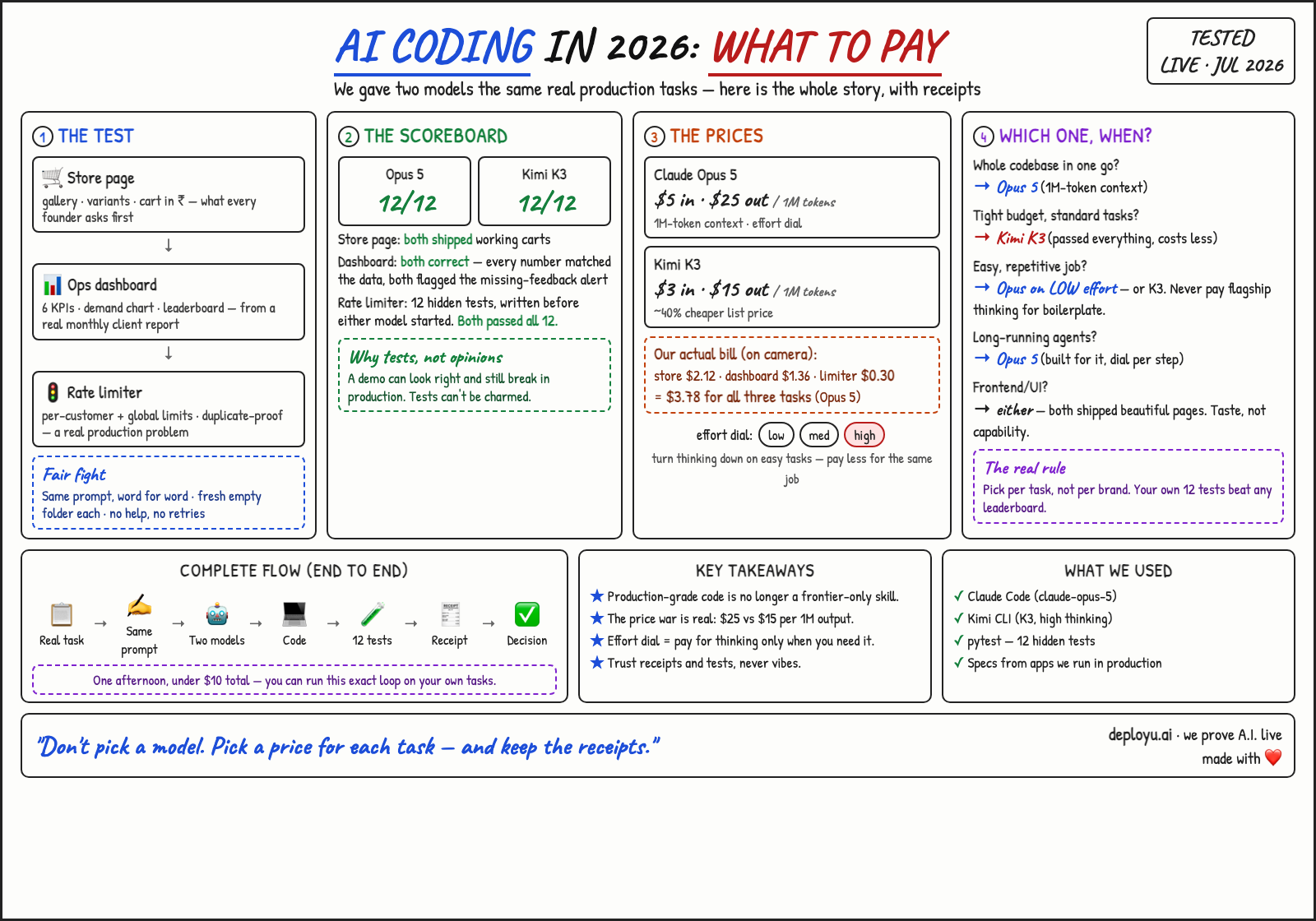
Here is the whole story on one sheet — save it, share it, argue with it:
The whole story in 60 seconds
We asked both models to build three things a real business actually needs:
- A store product page — image gallery, size/color variants, a working cart in ₹. The thing every founder asks an AI first.
- An operations dashboard — six KPIs, a demand chart, a staff leaderboard, live sessions — modeled on the real monthly report one of our production apps sends its client.
- A webhook rate limiter — per-customer limits AND a global limit AND duplicate-message protection. A real production problem we have been burned by. This one was scored by 12 tests the models never saw.
The result: both models passed everything. Both store pages work. Both dashboards got every number right — including flagging a subtle “feedback: 0 — needs attention” alert most humans would miss in the spec. And on the rate limiter, the blind scoreboard read 12/12 for Opus 5 and 12/12 for Kimi K3.
That is the headline most reviews won’t give you, because it doesn’t crown a winner: production-grade code is no longer a frontier-model monopoly. The real differences are price, speed, and taste.
The receipts
We recorded costs on camera as we went. This is the actual bill for Opus 5, not an estimate:
| Task | Opus 5 cost | Notes |
|---|---|---|
| Store page | $2.12 | 2,119 lines, ~7 min of building |
| Ops dashboard | $1.36 | 900 lines — and it caught a spec nuance about the trend metric |
| Rate limiter | $0.30 | 12/12 tests, 58 seconds of API time |
| Total | $3.78 | three production-shaped tasks, one afternoon |
Thirty cents for a rate limiter that passes a production test suite. Read that again — then remember what a contractor quotes for the same ticket.
The list prices (July 2026)
| Input / 1M tokens | Output / 1M tokens | Context | Extra | |
|---|---|---|---|---|
| Claude Opus 5 | $5 | $25 | 1M tokens | effort dial (low/med/high) |
| Kimi K3 | $3 | $15 | large | topped Arena’s frontend leaderboard |
Kimi K3 is roughly 40% cheaper on list price. It is not a local model (a common myth — the CLI talks to Moonshot’s API), and it is not free. Opus 5’s headline trick is the effort dial: you choose how hard it thinks per task, which means you stop paying flagship-thinking prices for boilerplate.
Which one, when — the rules we actually use
- Whole codebase in one conversation? → Opus 5. The 1M-token context is the feature nothing else here matches.
- Standard tasks on a tight budget? → Kimi K3. It passed everything we threw at it and costs less.
- Easy, repetitive work? → Opus 5 on low effort — or K3. Never pay for deep thinking on boilerplate; that is the single biggest waste of money in AI coding today.
- Long-running agents? → Opus 5 — built for it, and you can dial effort per step.
- Frontend/UI? → Either. Both shipped genuinely good-looking pages. At this level it is taste, not capability.
The meta-rule above all of them: pick per task, not per brand. Loyalty is a subscription fee.
Run this exact test yourself (the part worth stealing)
The most useful thing we did was not choosing tasks — it was writing the 12 tests first. Here is the loop, which costs under $10 and one afternoon:
- Pick a real task from your own work — not a toy. Something that has bitten you in production.
- Write the test suite before any model starts. (Tip: have one model write tests, the other model write code — they can’t collude.)
- Give every model the identical prompt in a fresh folder.
- Run the tests. The number is the verdict — a demo can look right and still break; tests can’t be charmed.
- Note the cost and time next to the score. That pair — score + price — is the only leaderboard that matters for your work.
Do this once and you will never again need to ask “which model is best?” on Reddit. You’ll have receipts.
The honest fine print
Both models ran with their default settings (Opus 5 via Claude Code, K3 via Kimi’s CLI at high thinking). Frontend was deliberately included because it is Kimi’s claimed home turf. Costs shown are our session receipts; your tasks will differ. Prices checked July 2026 — they change fast, which is rather the point of this page.
Learn AI engineering with receipts, not vibes
DeployU teaches on real cloud accounts and real production patterns — the same test-first loop from this page, as hands-on labs.